Showing posts with label Historical Sites. Show all posts

Monday, June 11, 2012

Sightseeing around NOLA


Friday, June 8 - We had a great day exploring New Orleans.  Some highlights:


We took the streetcar to the Garden District.  This streetcar line is the oldest continuously operated street railway line in the world, since 1835.


Most houses in the Garden District have light blue ceilings on their porches.  
It supposedly is a deterrent for bugs to nest there.

We explored Lafayette Cemetery No. 1 in the Garden District, 
which is on the National Register of Historic Places.

We had an impromptu tour from a caretaker of the cemetery.

We had lunch at the Camellia Grill at the other end of the Garden District.  
Recommended by Sandy's neighbors, Terry and Marty.  Lots of entertaining local color!

A new take on Spanish moss -- Mardi Gras beads!

Friday, June 8, 2012

Mobile and USS Alabama

Thursday, June 7 - Before heading back on the road, we took in a few sights in Mobile, Alabama.  First, we walked around historic downtown, which is pretty sleepy, but has some beautiful architecture and has some signs of urban renewal.  There's a beautiful cathedral down Dauphin Street.

Next, we stopped at Battleship Memorial Park and toured the USS Alabama, which saw action in WWII.  We went through all of the decks below to see how the sailors lived when at sea.  It was like a little city down there - with post office, store, doctors, dentists, laundry, uniform pressing and even a soda fountain, where they went through 100 gallons of ice cream every day!


Tuesday, June 5, 2012

Entering Georgia (again) and Jekyll Island


Monday, June 4 – Since we had that disappointing Georgia sign experience when we entered the state while going east in Week 1, we were looking forward to entering again as we came down the Atlantic Coast.  This sign along I-95, while maybe not the most beautiful, certainly gave us a good welcome.

Since we were literally just passing through the state en route to Amelia Island, Florida, we did want to make a brief stop along the Golden Isles of Georgia.  We took a detour over to Jekyll Island, not only to take a look at the historic Jekyll Island Club, but also because my aunt has a winter home here. 

The Queen-Anne style Jekyll Island Club Hotel, founded in 1886, did not disappoint.  It was created as a private, exclusive winter retreat for some of the world’s wealthiest people (like J.P. Morgan), some of which built mansion-sized “cottages” surrounding the main Club building.  Interestingly, we learned that the first transcontinental telephone call took place at the Jekyll Island Club between Alexander Graham Bell in New York, his assistant Thomas Watson in San Francisco, President Woodrow Wilson in Washington, DC, and Theodore Vail, president of AT&T in Jekyll Island.  Mr. Vail, a member of the Jekyll Island Club, was there recuperating from a leg injury, and was unable to be in New York.

Another interesting point of history: the first meeting that led to the creation of the Federal Reserve System was also held at the Jekyll Island Club. 

OK, enough history for now.


Monday, June 4, 2012

Drayton Hall plantation


Sunday, June 3 – After sadly packing up and leaving Charleston – such a great city – we headed up the Ashley River a bit to check out Drayton Hall plantation, another recommended stop by my friend Greg.  I feel like we had pretty much figured out the plantation drill on this trip, since we’ve been to quite a few, but this one was surprisingly different.  What makes it so, is that it has NEVER been “restored.”  It is still in original condition. That's right, original.  The current main house was built in 1738, and was kept in the Drayton family until 1975, when it became a property of the National Historic Trust for Historic Preservation.


We had a great tour guide Amanda, who was an historic preservation major, who told us how the family knew that they had a treasure in this property, and thus didn’t do any 20th century modernization to the house.  They never even installed electricity or running water, or installed modern kitchen appliances, even though it was still being used as a home.  There is very little modern paint in the house, and much of the carved plaster ceilings are amazingly still intact.  There is no furniture in the house, because there will be no attempt to renovate it to look like it did during any certain period.  Instead, they only conduct preservation efforts to maintain the house in it’s current condition, which they say is constantly ongoing.  They also continue to embark on archeology projects on the property to continue to research the history of the plantation as new tidbits of information are revealed.  Really amazing.  You get a very good sense for what life was like in the 18th and 19th centuries, and it is unbelievable to know that you're looking at the same untouched craftsmanship that was done hundreds of years ago. 

This is a “must do” for anyone visiting Charleston for anyone who has any interest in history and historic architecture.


Sunday, June 3, 2012

Fort Sumter


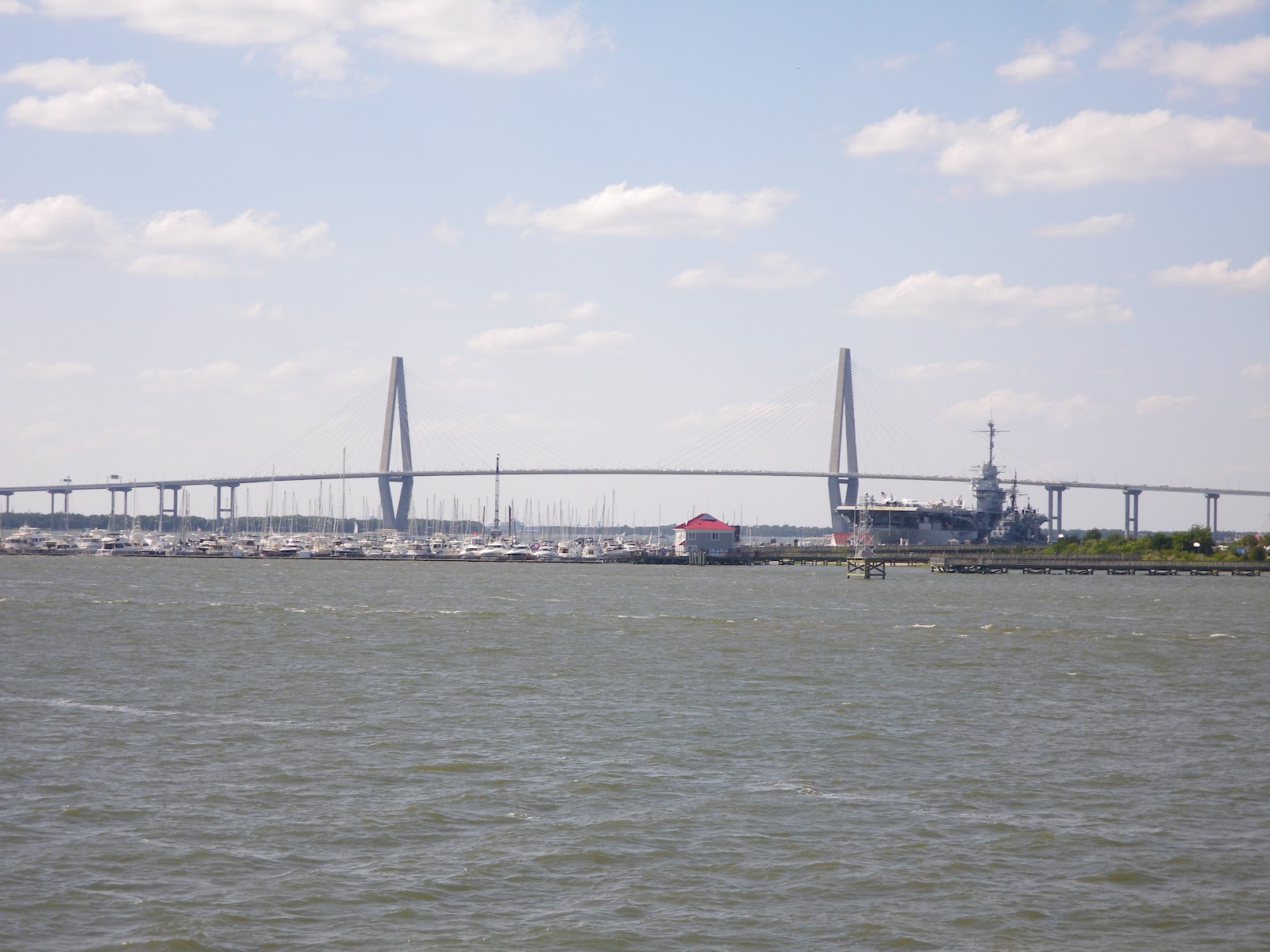
Saturday, June 2 – This, of course, is where the Civil War began.  Our overall assessment of the voyage:  Great ferry ride. Fantastic views of Charleston, the Ravenel Bridge and an aircraft carrier.  Very informed tour guide at the fort.  Good value for the money.  Even made friends on the ferry.  All that + beautiful day = Definitely worth it. 

We had such good seats on the top deck.  We - along with everyone around us - wanted to claim “same seats” for the ride back.  So, in the spirit of looking out for the team, which included a couple from Montgomery, AL on one side and a multigenerational extended family on the other, Sandy high-tailed it back to the ferry to save seats for everyone as most of the people were still taking their time in the fort.

As we were on our way back to Charleston from the fort, a “tall ship” on a cruise of the harbor also appeared.  Very appropriate.

BTW…  Today was laundry day, since it marked the end of week one.  We found a great Laundromat on the campus of the College of Charleston before we went to Fort Sumter in order to get our chores done.  It’s good to be clean.


Saturday, June 2, 2012

Girl Scout Mecca

Friday, June 1 – As a former girl scout, Sandy was pretty jazzed when she passed by the birthplace of the founder of the Girl Scouts in the Savannah historic district on her morning walk.  It must have been her inner Girl Scout that navigated her unknowingly down that street.  This year is the 100th anniversary of the Girl Scouts, and if Sandy had known that scouts from all over were making the pilgrimage to Savannah this year, she’d have brought her sash.

Wednesday, May 30, 2012

The Bus Stop

Wednesday, May 30 - This is THE Bus Stop.  The stop where Rosa Parks refused to give her seat up to whites getting on the bus.  That act prompted the 1-year Montgomery Bus Boycott.

This is just a couple of blocks away from our hotel, an historical building which was restored and is now a Hampton Inn and Suites.  We have the corner room on the 6th floor, which you're looking at in this picture.  I'm sitting in that room right now blogging... (And that's Sandy crossing the street in the picture.) Very nice location in downtown Montgomery.

Sweet Home Alabama


Tuesday, May 29 - Another new state for me.  Headed to Montgomery. Another small town we made a quick stop in is Demopolis (which means "city of the people").  Most noteworthy in Demopolis is a mansion called Gainsworth, which was called by the Smithsonian Historic Guide to America as one of the top three antebellum mansions in America.  Definitely worth a stop.  


Unfortunately, the hours published in the guidebook were out of date, and they closed about a 1/2 hour before we got there.  Bummer, since it still has the original interior finishings and furniture.


Side note:  We've been behind several big trucks hauling logs today.  It feels a little precarious following this...

The next quick stop was Selma, Alabama, best known as the home of the civil rights marches of 1965.  It also has one of the few intact antebellum business districts, spared in an attack on the town's factories for weapons and ammunition near the end of the Civil War in 1865.  One of those buildings is the St. James Hotel, which has been restored.

Selma was the home of "Bloody Sunday", March 7, 1965, which was when police officers attacked peaceful civil rights demonstrators on the Edmund Pettus Bridge as they were attempting to march to the state capital, Montgomery. After this occurred, President Johnson said:

"At times history and fate meet at a single time in a single place to shape a turning point in man's unending search for freedom. So it was at Lexington and Concord. So it was a century ago at Appomattox. So it was last week in Selma, Alabama."